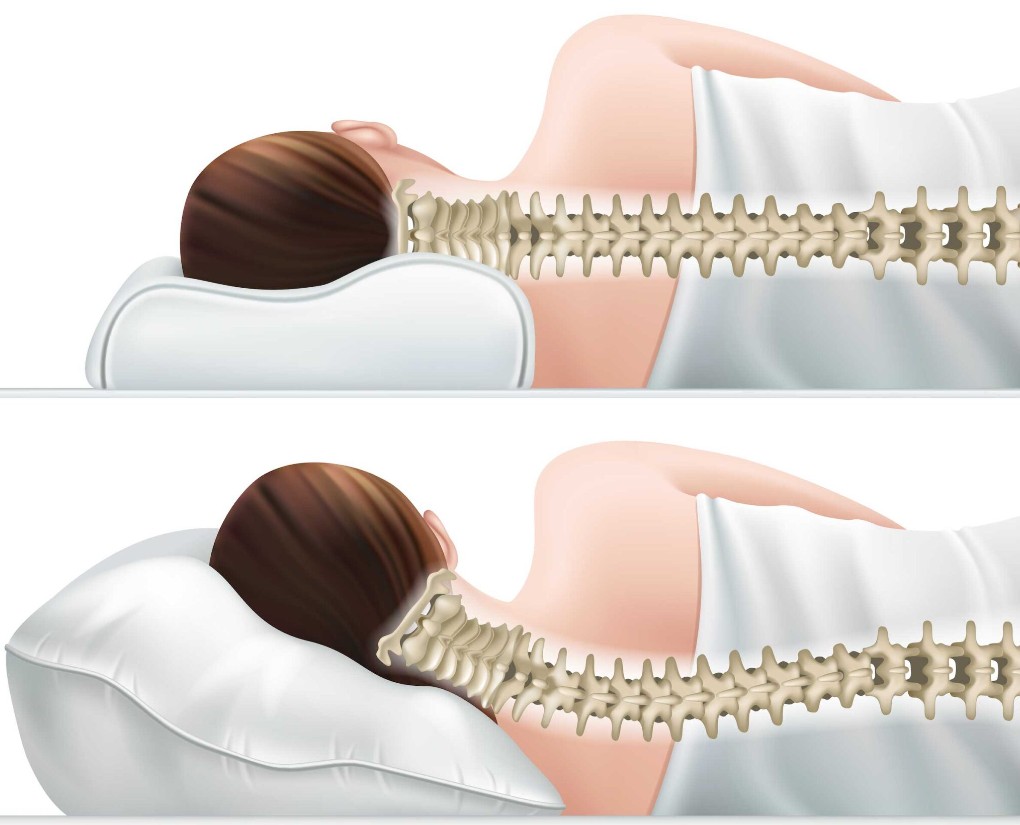
Find your best pillow
If you can’t sleep well on just any pillow and you are quite demanding, you’re in good company. Finding the right pillow is often more difficult than finding the right mattress. So, how do you choose the right pillow? Let’s start with the material:

Memory foam pillow
A memory foam pillow adapts to the natural curves of the neck and head, molding itself to support without creating pressure. A memory foam pillow is certainly a good choice for cervical support if:
you sleep on your side or on your back;
you do not place your arm under the pillow;
you do not find relief with down or soft fiber pillows.
Thanks to its shape-retaining properties, a memory foam pillow is recommended for proper cervical alignment, especially in medium heights such as 12 or 13 cm. It is the most popular type of pillow and therefore available in several versions and firmness levels. Among the best options in this height range are the Simmons Memoplan and Dorelan Sense memory pillows.
If you have a particularly firm, non-yielding mattress, or if your body type requires a higher pillow, I recommend the Gabrielli memory pillow with a 15 cm height.
Latex pillow
A latex pillow is an excellent choice for cervical support if:
you don’t like the slow-response feel of memory foam;
you sleep in a composed position, without hugging the pillow;
you are looking for soft, elastic support.
There are important differences between latex pillows and memory foam pillows. A latex pillow is more responsive than memory foam: as soon as you rest your head on it, it adapts immediately, without gradual sinking. You will feel a light elastic push, more noticeable than with memory foam. In general, latex pillows are softer and lower than memory foam pillows.
If you enjoy this type of comfort and do not need a very high pillow, the Simmons Planet 13 latex pillow is a good option. If you are looking for a more supportive and higher solution, a natural latex pillow with a 16 cm height is recommended.
To learn more, visit the cervical pillow page.

How to Test and Choose the Right Pillow
Is there a way to check whether a pillow is not only high quality but also suitable for you? Yes. Here’s what to look for:
Hand test:
Try touching the pillow without its cover, applying light pressure with your hand. Do not press too hard, because the pressure of your head is more evenly distributed than that of your fingers, which press on a very small area. A strong pressure test can therefore be misleading.
Breathability test:
If the store or situation allows it, bring the pillow close to your mouth and gently blow on it. If you feel a lot of warm air returning to your lips, the pillow has poor breathability.
Weight test:
If two memory foam pillows have different weights, this usually means they have different densities. The heavier pillow will generally be less yielding and offer firmer support.
How to Evaluate the Right Pillow Height
If you need to replace your pillow and want to start from the correct height, keep in mind that:
- the density of the pillow, and therefore its firmness and level of support, affects how a higher pillow will actually feel;
- the ideal pillow height may change if you change your mattress;
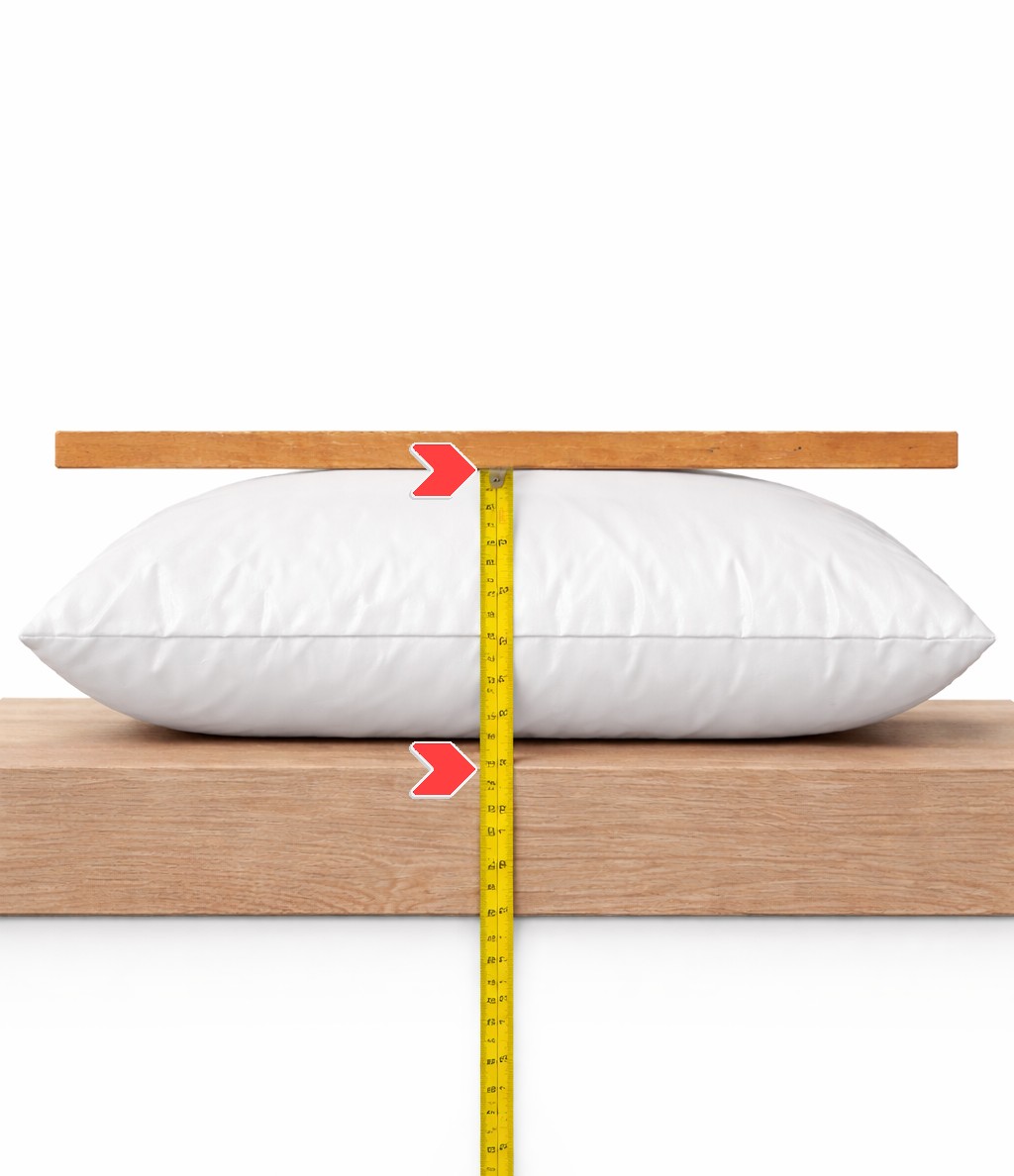
- if you need to measure a pillow, make sure to do it correctly, using a rigid straight edge and placing it on a flat surface.

Measuring the height of a pillow is not as simple as it may seem.
Unlike a rigid object, a pillow is a deformable product that changes shape depending on how it is placed, supported, or compressed. For this reason, height should be considered an indicative value, useful as a reference point, but not sufficient on its own to describe the real comfort of a pillow. One of the most important factors is the density and nature of the material. A memory foam pillow, for example, may appear quite tall but compress significantly under the weight of the head, while a latex pillow with the same stated height may feel more responsive and supportive. As a result, two pillows both described as “13 cm high” can provide completely different sensations during use.
The internal structure and shape also play a major role. A solid slab pillow behaves very differently from a perforated or channeled one. Holes and internal processing improve breathability, but they also affect elastic response and the perceived height once you are lying down.
In short, pillow height should always be evaluated in relation to other factors: material, density, elasticity, internal structure, and sleeping position. Judging a pillow solely by its stated height can be misleading. Real comfort is achieved when the head, neck, and shoulders find the right balance, not when you read a number on a measuring tape.