

Why do you feel stiff or not well-rested in the morning after sleeping, as if you hadn't slept a wink? It could be due to the mattress's inability to support and cradle you correctly, being either too firm or too soft. If the mattress is too resistant to your hips and shoulders, it will cause you to change position frequently, leading to awakenings and micro-awakenings that interrupt your sleep cycles, which are crucial for restorative sleep.
Why the absence of pressure points in mattresses is essential
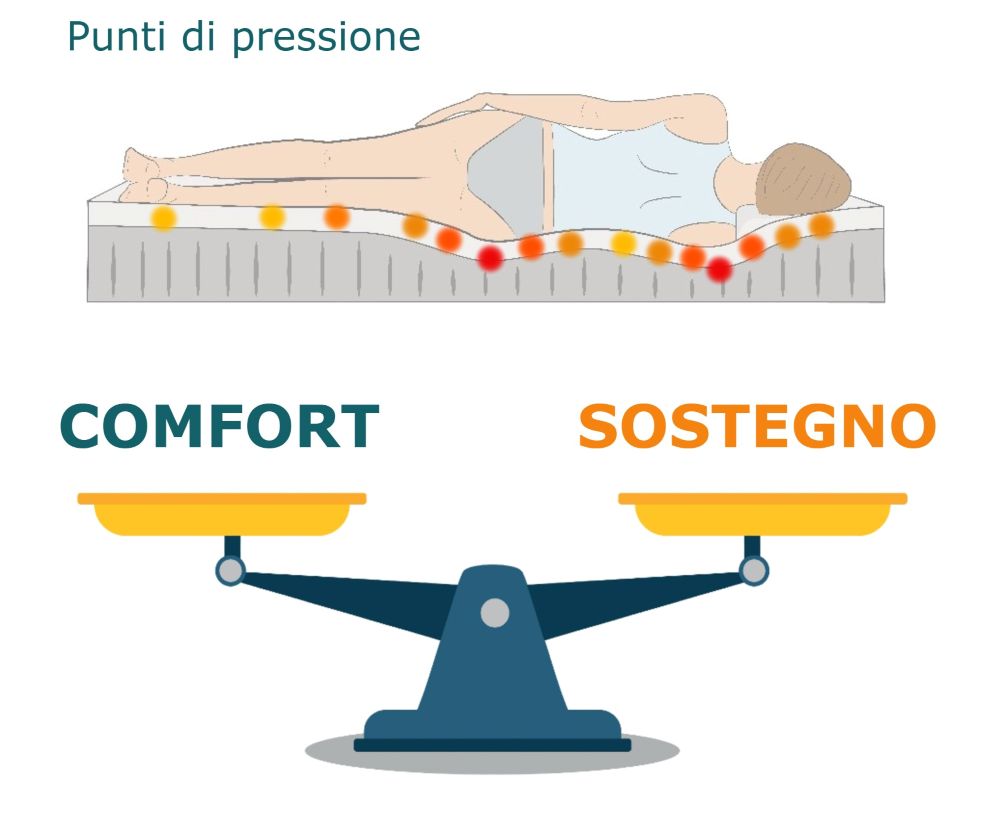
Why do you feel stiff or not well-rested in the morning after sleeping, as if you hadn't slept a wink? It could be due to the mattress's inability to support and cradle you correctly. If the mattress can eliminate pressure points, it is the right mattress for you. The right mattress for you is simply one with the right mix of superior comfort and support. This mix is achieved by correctly balancing the surface materials, which are in direct contact with your body, and the support primarily provided by the more central and base layers of the mattress. The perfect synergy between comfort and support will eliminate pressure points and create a floating sensation, where you are supported without excessive pressure, which is detrimental to your muscles, vertebrae, and venous circulation.
Good sleep and muscle recovery
Hard or soft? A mattress should support, not be hard; it should be welcoming, not sink. Support should not be translated into hardness or rigidity; it should mean that your body is kept in the correct position without feeling the mattress's push, which should not be repellent. At the same time, it should welcome you, but you should not sink into the mattress. This good balance between support and welcoming in a mattress is found in multi-layered mattresses, quite tall (at least 28 cm), that combine pocket springs and advanced memory foam with differentiated firmness, with thick coverings and often with an additional layer of micro-springs.
Hybrid mattresses
A hybrid mattress is a definition given to mattresses with springs and memory foam, combining the two technologies. It is essentially a pocket spring and independent spring mattress with the addition of a few centimeters of memory foam, generally from 2 to 6 cm. The addition of memory foam in these mattresses is an upgrade to superior comfort, meaning increased welcoming in the top layer, in contact with the body; it doesn't completely transform it, but it alleviates the pressure of the springs.
Differentiated firmness
7-zone, 9-zone, and even 11-zone mattresses, which one is best? Differentiated zones in mattresses are a feature that guarantees support distributed differently across zones. Starting from the center of the mattress with greater support, rigidity gradually decreases in the head and leg zones symmetrically. Is a mattress with differentiated firmness truly effective? This difference is imperceptible; in fact, many believe it's a marketing gimmick rather than a real benefit. What would happen if you slept in a fetal position, with your body more curled up? Would the mattress then feel different depending on your height? How can it be suitable for everyone?
The high-performance mattress
Ensuring differentiated firmness can mean that the mattress is highly performant and adaptable in all zones, not necessarily different in each zone. Therefore, it must be made with the right mix of materials combined to cradle you correctly whether you sleep on your back or side, whether you weigh 60 or 100 kg, thus promoting good sleep for couples, where weights are often very different.
In conclusion, the mattress capable of eliminating pressure points is a pocket spring and memory foam mattress, with natural fiber or hollow polyester fillings, supported at the base and comfortable on the surface, about 28/30 cm high. If it meets these parameters, it is almost certainly a high-end product and will cost over 1500 euros for a double. Mattresses with these characteristics include Simmons (starting from 2000 euros) and Gabrielli (starting from 1500 euros).


